
By Resident Inspect (Guest Contributor)
| Editor’s note: This article discusses Washington’s Residential Landlord-Tenant Act (RCW 59.18) in general terms. It is educational, not legal advice, and outcomes in a specific dispute depend on the facts, lease terms, local ordinances, and current law. Property owners should consult qualified Washington counsel regarding their specific circumstances. Primary legal sources: RCW 59.18.260 and RCW 59.18.280. |
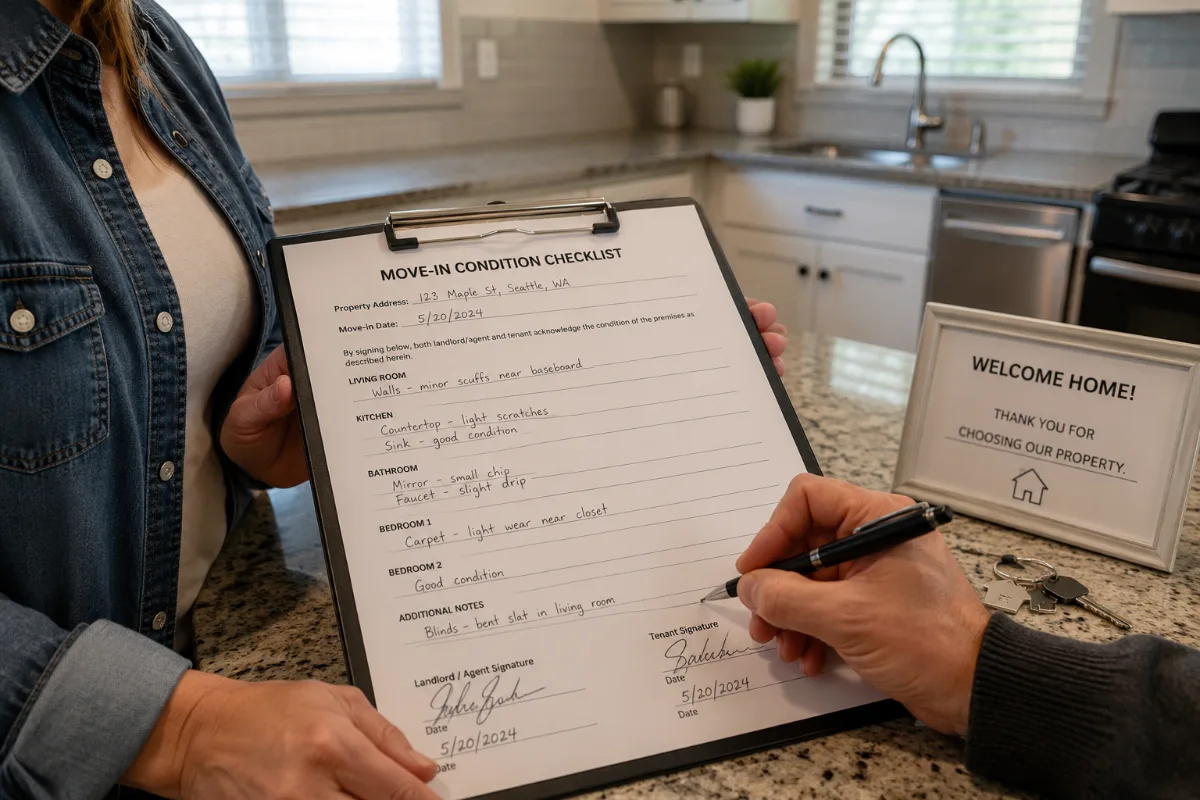
A tenant hands back the keys on a two-bedroom in Everett. You walk it. There is an eighteen-inch gouge down the hallway drywall, a scorched ring melted into the laminate counter, and a bedroom door hanging from its middle hinge. Conservatively, it will cost $1,800 to make the property right. You itemize the damage, deduct it from the deposit, and send the statement.
Three weeks later, the tenant disputes every charge and threatens small claims. The argument is one sentence: “Prove it was not already like that when I moved in.”
And you are not sure you can.
You know the damage was not there. But the move-in checklist says only “Good” in every box, it is in your handwriting, and it was never signed by the tenant. There are no dated photographs. The dispute comes down to your recollection against the tenant’s denial – and the party with the clearer documentation usually has the stronger position.
This is not simply the cost of doing business. It is the cost of one weak document – and in Washington, that document carries more legal weight than many owners realize.
YOUR WASHINGTON SECURITY DEPOSIT CHECKLIST IS NOT A FORMALITY
A Washington security deposit checklist is not just move-in paperwork; it is part of the legal foundation for keeping a deposit at all.
Under Washington’s Residential Landlord-Tenant Act, a landlord may not collect a security deposit unless the rental agreement is in writing and the tenant receives a written checklist or statement describing the condition, cleanliness, and existing damage to the rental at the beginning of the tenancy.
The checklist must be signed and dated by both the landlord and the tenant, and the tenant must receive a copy. That makes the checklist more than routine move-in paperwork. It is part of the legal foundation for collecting the deposit and can determine whether later damage deductions are allowed.
If the landlord collects a deposit without providing the required checklist at the beginning of the tenancy, Washington law makes the landlord liable to the tenant for the amount of the deposit. The prevailing party may also recover court costs and reasonable attorney fees.
The practical risk is clear. If the checklist is missing or was not properly signed and provided, a landlord can lose the ability to rely on the security deposit for damage deductions. Even when a checklist exists, vague descriptions may prevent deductions for particular fixtures, equipment, appliances, furnishings, or other conditions that were not reasonably documented.
A landlord may still have other lawful avenues to pursue a tenant for damage beyond the deposit, but losing the deposit remedy means losing the fastest and most readily available source of recovery.
ORDINARY WEAR IS STILL THE LANDLORD’S RESPONSIBILITY
A valid checklist does not make every repair chargeable to the tenant. Washington law prohibits withholding a deposit for wear resulting from ordinary use of the premises.
Faded finishes, normal traffic wear, and aging that occurs through ordinary use are generally part of owning and operating a rental. Damage is different: a burned countertop, a broken door, a large drywall gouge, or damage beyond normal use may support a deduction when the landlord can establish the original condition, the changed condition, and the reasonable cost of repair.
That creates two separate documentation needs. The landlord needs a compliant move-in checklist to establish the agreed starting condition, and the landlord needs evidence showing that the condition materially changed during the tenancy.
WHY WEAK RECORDS QUIETLY INCREASE TURNOVER COSTS
Every dollar of genuine tenant-caused damage that cannot be substantiated is a dollar the owner absorbs instead of recovering – quietly padding turnover costs, turn after turn.
A deposit dispute also creates administrative work, collection difficulty, possible legal expense, and uncertainty over how much of the repair cost will ultimately be recovered. A contested move-out can also produce a negative review that affects the next leasing cycle. None of those costs appears as a separate line on the make-ready invoice. They simply leak out of the property’s margin.
WHAT TENDS TO HOLD UP — AND WHAT USUALLY DOES NOT
The pattern is straightforward: persuasive documentation is specific, dated, signed where required, identifiable, and comparable. Here is how common records tend to compare.
– “Good” in every box — weak. A checklist that rates every room “Good” or “OK” describes little that can be measured later. It is difficult to rely on when the dispute concerns whether a particular countertop, door, appliance, or wall was already damaged.
– An unsigned checklist — weaker still. If the tenant never signed and dated the checklist, it reads more like the landlord’s unilateral notes than an agreed record of condition. It may also fail the statutory requirement.
– An undated photograph — limited. A photograph with no reliable date or context may not establish when the condition existed. Embedded metadata can help, but the image is stronger when it can be connected to a particular inspection, property, room, and date.
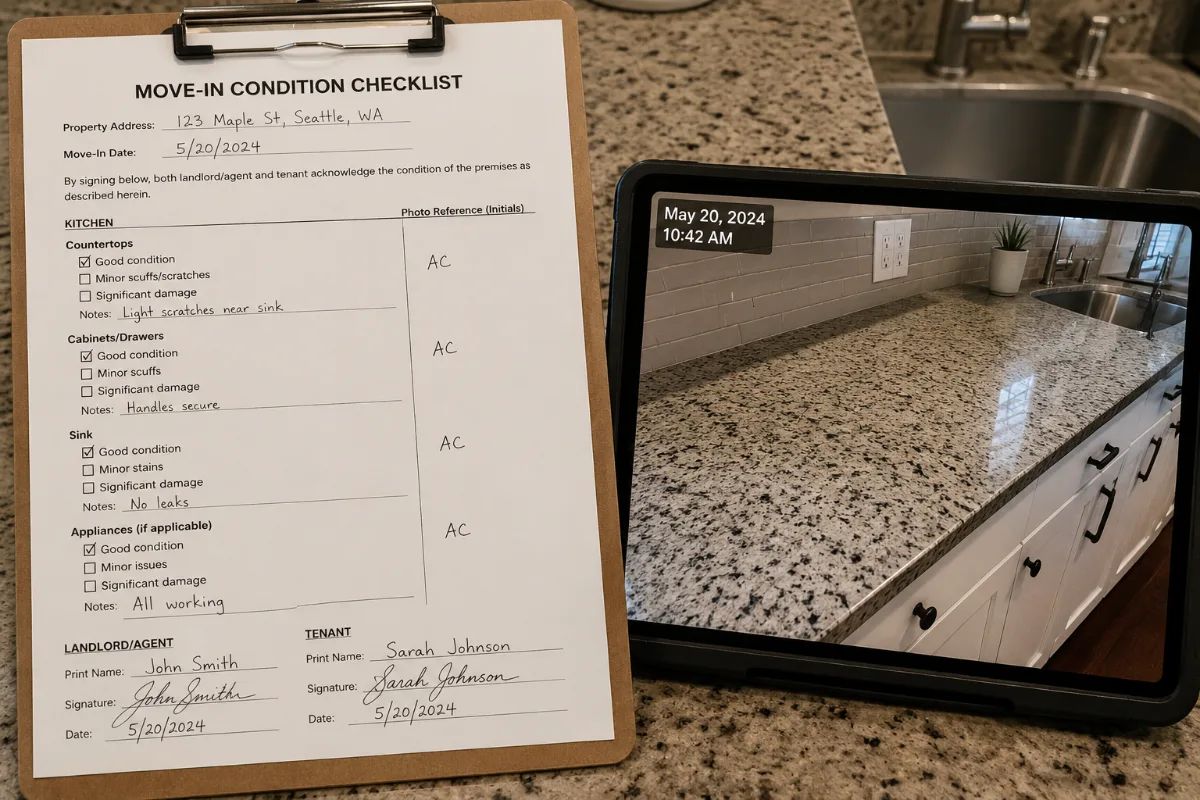
– A specific, signed, dated checklist — strong. “Kitchen counter: laminate intact, no burns or chips; cabinet faces clean; sink undamaged,” signed and dated at move-in, creates a measurable starting point.
– Comparable move-in and move-out images — stronger supporting evidence. Dated photographs of the same surface from similar angles make the change easier to understand. A move-out photograph with no comparable move-in record is only half of the evidentiary story.
The signed checklist and the photographs perform different jobs. The checklist is the legally required agreement about the starting condition; the photographs and inspection records are corroborating evidence. A landlord is best protected by having both.
STRONG EVIDENCE STILL HAS TO BE DELIVERED CORRECTLY
Even excellent before-and-after documentation does not replace Washington’s move-out requirements. Generally, within 30 days after the rental agreement ends and the tenant vacates, the landlord must provide a full and specific statement explaining any amount retained from the deposit, together with the refund due.
Damage charges must also be reasonably substantiated. Washington law calls for copies of estimates received or invoices paid. When the landlord or an employee performs the work, material charges should be supported with receipts, invoices, vendor price lists, or similar documentation, and labor charges should include the time spent and the reasonable hourly rate.
Condition records establish what changed. Estimates, invoices, receipts, and labor details establish what the change reasonably cost. A strong claim needs both.
CLOSING THE GAP WITHOUT ADDING UNNECESSARY WORKLOAD
The written, tenant-signed checklist remains the landlord’s or property manager’s responsibility at move-in. A camera, application, or third-party inspection report does not replace the document that Washington law requires the tenant and landlord to sign and date.
Where many owners lose ground is in the evidence that sits alongside the checklist – and in the consistency of that evidence across the portfolio. A move-in record is most useful when a comparable move-out record covers the same rooms, surfaces, and major components with a similar level of detail.
Consistency becomes harder as portfolios grow, or for out-of-state owners who cannot walk each property themselves. The quality of the file may depend on who happened to inspect the property that day. One person creates a detailed record; another writes “looks fine.” That leaves liability exposure uneven from one home to the next.
Some owners handle the photographic documentation themselves with a disciplined process. Others rely on their property manager. As portfolios scale, some use a dedicated inspection service to keep the documentation uniform.
This is where a partner such as Resident Inspect fits. Resident Inspect creates standardized, timestamped photographic condition reports through live guided inspections. The report provides a consistent corroborating layer that supports the landlord’s signed checklist rather than replacing it. The result is specific, dated condition evidence produced in a repeatable format across every property – without requiring another trip across town.
THE BOTTOM LINE
Turnover will always cost something. But repair costs that cannot be recovered and disputes that consume time often trace back to two things that can be controlled at move-in: a properly completed, tenant-signed checklist and consistent dated evidence supporting it.
Before the next move-out, pull the move-in records and ask one blunt question: if the tenant challenged these charges, is the starting condition specific, signed, and backed by dated proof?
If the answer is “not really,” that is more than a paperwork gap. It is a deposit already placed at risk – and unlike repairing drywall, improving the next move-in record costs very little.
ABOUT RESIDENT INSPECT
Resident Inspect helps landlords and property managers capture consistent, timestamped photographic condition documentation across an entire portfolio. Its live guided inspection process creates the corroborating record that supports a compliant move-in checklist when a deposit is challenged. Resident Inspect is a documentation service – not a substitute for the tenant-signed checklist or for legal advice.
========================================================================
FREQUENTLY ASKED QUESTIONS
| Q: What is required on a Washington security deposit checklist?
A: Under Washington’s Residential Landlord-Tenant Act (RCW 59.18.260), a landlord generally can’t collect a deposit unless the tenant receives a written move-in checklist describing the condition, cleanliness, and existing damage of the rental. It must be signed and dated by both landlord and tenant, with a copy given to the tenant. This is general information, not legal advice. |
| Q: Can a Washington landlord keep a deposit without a move-in checklist?
A: Generally no. If a deposit is collected without providing the required checklist at the beginning of the tenancy, Washington law can make the landlord liable to the tenant for the amount of the deposit, and the prevailing party may recover court costs and reasonable attorney fees. |
| Q: What documentation holds up in a security deposit dispute?
A: Evidence that is specific, dated, signed where required, identifiable, and comparable: a specific signed and dated move-in checklist, plus comparable move-in and move-out photos of the same surfaces. For deductions, RCW 59.18.280 calls for estimates or paid invoices, with labor time and rate documented when work is done in-house. |
| Q: Does a photo or inspection report replace the tenant-signed checklist?
A: No. Photos and inspection reports corroborate condition, but they don’t replace the written, tenant-signed checklist Washington law requires the landlord and tenant to sign and date. |
